![]()
31 August RainsFor non-resident members who have been seeing national news reports about mid-west flooding and emailing us concerned about river bottom hunting the past week or so rest assured it was a disappointing amount of local rainfall. The local storms all looked impressive on radar and dropped little accumulation. All the recent flooding reported on the national news was well north of the MAHA region.
The Missouri River just north of Kansas City at what appears to be normal flow.
LandA topic always of interest to members is the acquisition of new leases believing "new" land being better than older leases. That is not always the case. Our discussion here is intend to be just a snap shot into the world many members believe would be an ideal job (hunting club) to have failing to realize that any job no matter how "cool" it appears does in the end amount to simply work.
The leases added are in fact habitat quality improvements within a specific region based on the Association's membership primary and secondary hunting interest overall profile and during season hunter pressure monitoring. However, any one new lease is an improvement for what the land is being leased for and never is any one lease considered good for all hunting disciplines. While this may not be new information to any one person, it does warrant stating as it does happen that new lease acreage generates the same questions from multiple hunting discipline members and that is, is the new land good for deer, upland, turkey etc. The answer is already within the grasp of the one asking the question with the prevalence of wildlife listing at the map bottom. That prevalence listing is why that land was leased.
New land does come at a cost. The first cost is it is not our organizational goal to have a consistent flow of incoming new land. We seek and prefer long term relationships as a matter of economics of reducing overhead as the greater the lease renewal frequency the higher the overhead. That by itself can narrow down the field of prospects.
The next cost is that rarely does a contract result from the first meeting.
One of our value points is our collective buying power along with a lawyer and insurance coverage opens the door to other than single owner land groups of large acreage. Such groups do not enter into any business relationship lightly and there are always competing concerns. More often than we would like some of our best land has come at the cost of more than a year's time of contacts with the owning entity. Recurring negotiations all cost time, fuel and fail to fit into the models some members attempt by taking total membership inflow, develop a uniform price per acreage lease rate, estimate salaries and derive that a hunting club has a large profit margin. This fails to account for the many ankle biter type costs collectively identified as overhead and beyond the scope of this discussion.
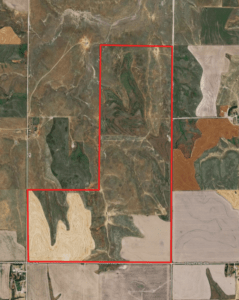
The pictures below are of a potential lease where the process has resulted in a verbal agreement to be followed by a written contract once prior obligations are eliminated by the owning entity and the Association makes money available through dropping lesser quality lease land and membership dues are collected.
This lease will come at about a year's worth of time of infrequent communications and in person visits. Each party is currently in the double check and confirmation mode that when it comes together will provide some very good deer and bird ground superior to about 50 % of the current inventory. Once the contract does come due to be signed the Association must have the money at hand and this is a good example why when a members' dues come due to have them paid on time as that all member dues are on a programmed budget to pay for all current and pending lease agreements whenever they come due throughout the year. There are not dollars waiting around to be spent. In/outflow is programmed to the extent of existing multi year contracts. A seemingly no brainer that also warrants stating as there does exist that 1% that always saps from the 99% good hunter/members that make the work all worth while.
Now some pictures of a lease to come that any deer or upland bird hunter will be well pleased with.
This is one of those rare leases composed of multiple use land without cattle. For those deer hunters that believe the bigger the wood lot the bigger the deer will find this wood lot as big as they come in our region. It is as thick in all directions as it looks.
Broken throughout the lease are these combinations of grain fields, fallow fields and woods.
That is tall grass CRP. All bird hunters will recognize the tall grass seed head at the left of the picture.
This lease is not contiguous acreage, but a land holding covering more than one locality.
While this discussion may have been a bit off from the routine on the update page it is a glimpse into the behind the scenes of the work level your Association staff puts forth for the Association hunter/membership. It does answer a myriad of interest topics posed through recent membership feedback and also intended to be informative to those that may have thought but did not ask for these answers.
Good luck to all this coming season. We have in fact picked up some very good land this year. The deer numbers to include velvet trophy potential bucks higher than normal, northern duck counts are high and two of our regions should have very good upland bird numbers this year. All in all there is a lot of potential for some very good hunts.
AerialsThanks to Gary for this website, flashearth.com, of easy to use color aerial photos.
29 August MapsWe've made several maps changes the last 2 months and will have more in the near future, so please check each map before you make a reservation to make sure you are working with the most current maps.
Each map has the date the map sheet was modified and posted in the updated column on our map website. It would be very sensible to throw old map books and CD's away and use the maps posted on our map website. Several of the farms we deleted were sold for big money to individuals that bought the land to hunt. Please be advised hunting land with old maps that is no longer leased to the club can create serious problems with both the new landowners and the law. Last week we came very close to ending a long term landowner relationship over a member (using an outdated map) hunting a farm that was deleted. The biggest problem the landowner had was the member also had the new map in his possession. The implied is the member knew better than to have hunted where he was.
In general while less than 10% of our land is affected each year, 95% of the map changes are due to additions and deletions of land, while the other 5% are changed because of typos, highway changes, directions, etc.
Holt County WaterfowlIn June, Northwest Missouri saw torrential rainfall. The majority of the Missouri River bottoms around Mound City were under water on and off several times, which was a disaster to crop producers. The landowners who own our wetlands had to replant some of their crop up to three times, so they decided to leave the waterfowl area, which is their lowest land out of production this year.
In a previous newsletter, we displayed an effort to plant millet and milo on the low lying areas of the lake bed and harrow in the seed. Jon and Jon Jr. spent 4 days working the project and phase one, planting, was completed successfully. Phase two, which includes rainfall to germinate the seed did not happen for over a month. Noxious weeds took over and choked out the little millet and milo seed that tried to take, so the landowner sprayed the weeds, which put an abrupt halt to our efforts.
Despite the lack of crop in the duck marsh there is 1100 plus acres of irrigated corn planted (our lease) to the east of the duck marsh, which is available to the members.
When these photos were taken we noticed most of the duck marshes in the area were not planted, so our problem appears to be common in this area for the 07 season. One thing is certain, we will have water and lots of it with some weed seed for the ducks to feed on and cut corn close by.
The blinds as left over the winter will be covered with fresh rippy grass after teal and before regular duck season. July 2007 updates page 1 2 3 4 5 6 7 8 9 |
|
|
|