December 2006 page 5 Hunting Updates

21 Dec

Change

Most hunters will agree that hunting, farming and conservation have an undeniable linkage and if any further proof is required of this truth recognize that MAHA's best hunting is within the 45 to 55% farming land use region. All should also agree that farming, hunting and conservation has changed markedly within our lifetime and that further change is expected. Anticipating future change and how to adapt to it is the challenge. The following email conversation shows what some of the future may hold.


Form Gaylen (long time bird hunter) that started the conversation:

Interesting comments/feedback from members. I enjoy reading such. I can only state every hunt is different. Sometimes good sometimes bad. That is why they call it hunting vs. killing. Last weekend I made my first trip to the [location deleted] side. Hunting alone with my brits, I had a limit of pheasants in 2 hours. I found a covey of quail, took a few and went home, happy. Also, saw a buck of my dreams. This was after the [stated deleted] deer season. I can't argue there may not be as many birds as we like, but it may be as good as it may get for a while. If you have not noticed, grain prices have sky rocketed this past 6 months. With the push on bio-fuels (ethanol plants are pushing grain prices up), we could see more and more prime habitat go back to row crop. We need to do all we can to preserve habitat for the future. It will be greatly challenged in the coming years.


From John (MAHA Staffer):

The bio-grain topic was raised on the ag-report several months ago stating that even if we put back into production all set aside acreage additive to current farmed acreage we will meet the USA growing population food demands and our fuel requirement, however exports of grain to dependent nations will not be possible. If true, that is sobering. I have shared these comments with someone that will know better than all of us. He is in the CC line and is a grain commodity broker. Pedro, any inside the industry feedback?


From Pedro (upland and waterfowl hunter and grain commodity broker):

Approx 37 million acres currently enrolled in CRP program in the US. Majority of ground is highly erodable, marginally productive, and costly to bring back into production, albeit $4.00 corn and $5.00 wheat would make it somewhat easier.


You could argue the scenario that, at current commodity prices, 10 to 15% of the total CRP acreage could "come out" in the next 5 years, much more than that would be highly unlikely. The program is very popular with both conservationist and producers, the USDA will find a way to maintain acres.


As commodity prices rise they stimulate agricultural production in competing nations. US exports will suffer as we consume greater quantities of corn for the production of ethanol and soybean oil for the production of bio-diesel. Altogether, not a bad scenario for the US farmer, as the value added component of processing the commodity into fuel, remains here at home, rather than exporting the raw commodity and allowing importing nations to add value in the form of feed consumption, milling...


Makes my job as a wheat exporter a little bit tougher. Much easier to sell $3.00 wheat vs. $5.00 wheat.


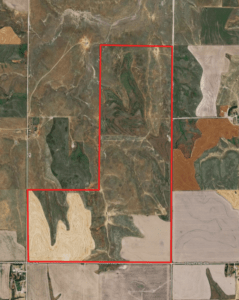
Pedro also supplied this map showing land costs changes.


Finally, from John Wenzel (hunter, MAHA staffer and alfalfa farmer):

It all comes down to money. The farmer will work his land or lease it for whatever he gets the most income (row crop, pasture, government conservation programs, hunting). In my case alfalfa, suited to the recreational horse market, brings the best money compared to equipment, maintenance, time and storage costs). Increased corn prices will make for more grain and less forage production making my choice all the better as well and an example of the secondary effects linkage within farming.


Tenet farming has always been competitive as the proficient farmer never seems to have enough tillable or pasture acreage. Higher gain costs will increase that tenet farmer competition. In my area of Kansas, land rents are a seller's market with multiple buyers paying increasingly higher land rents over the recent years. An example is the recreational horse (again my area of knowledge) pasture hit a recent high of $150/horse/month plus daily grain.


Government conservation programs have always been time consuming (year long process is typical), costly startup and average at best payments from the farmer perspective (on my farm the payments were so low and restrictions high to the point I declined the WHIP program for pasture land and the CRP program for tillage acres was not even close to what I earn with alfalfa). This is one reason why government programs work better in some states than others as evident by comparing Iowa to Kansas large field tall grass CRP (again using my example it is a matter of short distance between production and buyer. Alfalfa sells for less at greater distances from suburban recreational areas). Overall, it is money that will drive the change in the farming, conservation and hunting linkage.

Loading out a buyer from one of John Wenzel's alfalfa fields.

December 2006 1 2 3 4 5 6


Update Archive


Kansas Hunting

Iowa Hunting

Missouri Hunting


Deer

Turkey

Upland Bird

Waterfowl