Upland Bird HuntsKansas Quail Missouri Quail Iowa Quail 
Quail Hunt Quality Singles Hunting Wind Wash Quail Lease Quail Dog Power | Self guided quail hunts or do it yourself quail hunts within Mid-America Hunting Association is defined within this article. Within our concept of paid private land hunting access Mid-America Hunting Association (MAHA) secures hunting land lease and hunting access by written contract complete with liability coverage. MAHA then makes all lease land available to all fully paid members through a web site map library posting all contracts as added or deleted throughout the calendar year. 
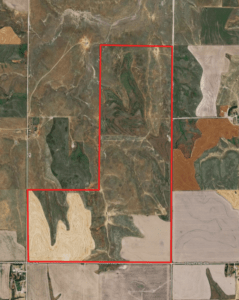
An example of a single quail hunting unit composed of over 3,000 acres. The leases are highlighted as black blocks on the maps sheets. The red boxes are additive to this illustration showing the acreage per block be it a section at 640 acres, a 1/2 section of 320 acres, or a 1/4 at 160 acres and so on. Each quail hunter would reserve a unit or more each day dependent on locality and cover quality to ensure more acreage per day than time available to hunt. Not all acreage on any single map sheet or upland bird unit has huntable habitat. The grain farming and watersheds that make for our good quail hunting also allow for efficient agriculture and the best quail hunting is within that region that ranges from 45% to 55% agricultural land use. This means that in the very best of cases any one map sheet of any acreage typically has 1/2 of the total acreage not available to wildlife. In this case of a 3,000+ acreage maps sheet there may be expected to find 1,500 acres of wildlife habitat. Within that 1,500 acres of wildlife habitat not all of it will support quail hunting and so on. While this discussion may make it seem like a daunting task of finding the right spot where to hunt the reader should relax with the understanding that Mid-America Hunting Association is a business and not a hunting club. As a business we know that a good hunt will bring the hunter back to renew his membership. Second is that both the Association owner Jon Nee, hunter of pointers, and the partner, John Wenzel, hunter of multiple pointing breeds, will recommend to the new member where to hunt for what he is after. |
Any lease land added and posted to the website will be done so within a couple of days of receiving the signed contract and all added land will have a contract ending date through the end of the next hunting season. On occasion as a matter of exception some land leases may be deleted during the hunting season. These cases largely revolve around land sales generated by bankruptcy, landowner death, or investment land that was sold in accordance with our leasing agreement. In these cases the on-line map inventory is updated within a day or two of lease loss. The map sheets serve as the discussion basis when communicating between the Association and the hunter. Quail hunters when planning a hunt would call and talk to one of the two Jo(h)n's who are pointing bird dog hunters themselves. The discussion of where to hunt will be based on bird of preference and in this case if wanting quail only or a mixed bag hunt of pheasant and quail; habitat preference and any driving distance and direction issues. The recommended locality would be identified by state, county, county unit letter (A, B, C and so on) and in the case of going to a mixed habitat type unit recommendations right down to property numbers where to hunt first. After the first trip or two the quail hunter will gain confidence at identifying good quail habitat and start enjoying the added adventure of hunting new lessees each time out. Quail dogs are about the quail hunt not quail in the bag. 
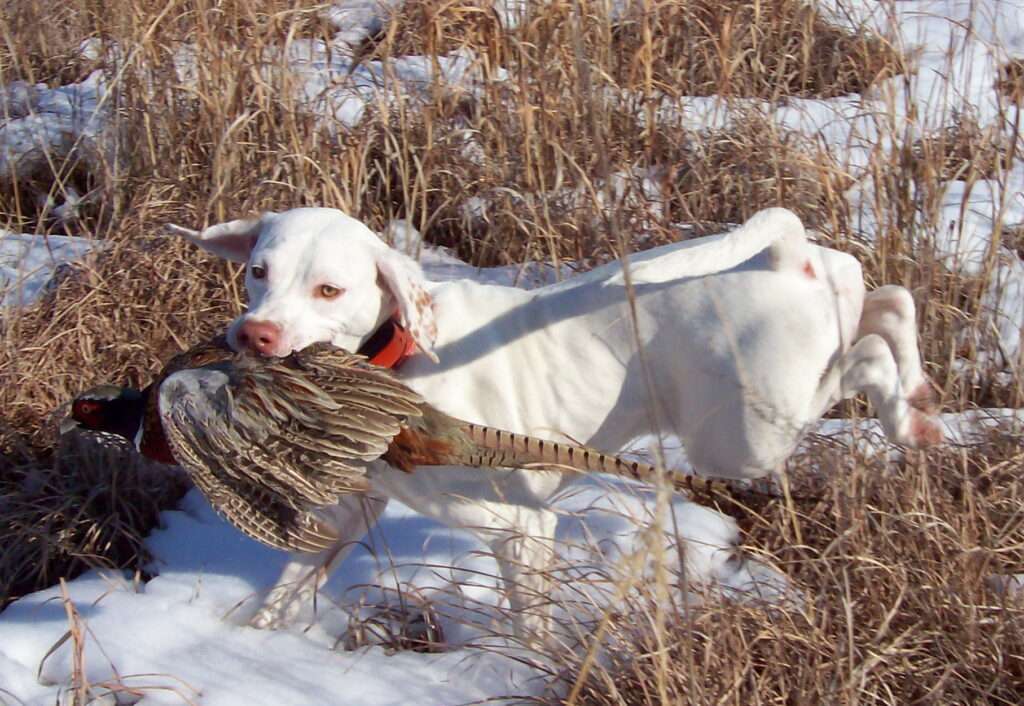
Quail hunting where trying to get that great dog on point picture is first, shooting the quail second. When a hunter gets to this level he has a much more leisurely approach to his hunts than could ever be achieved on public lands. This picture is not quite there with the ear flipped. |
Each member/quail hunter will before making a reservation have sufficient recommendations from ether Jon Nee or John Wenzel to think over his final hunt planning and call in a reservation for up to three days to start his hunt. The quail hunt plan would include considerations from which direction the hunter was traveling form as a means to identify the nearest regional locality that meets his hunting preferences. That near location will allow for an initially shorter drive. Frequently, this allows for a partial day hunt on arrival day. From this point the quail hunter will continue his planned first couple of days and modify his plans on the go as he finds better or worse hunting conditions. This level of during the hunt flexibility gives choices should conditions change and often means a better hunt rather than having to slug it out. An easily recognized illustration of hunt flexibility would be if adverse weather moves in from the north and blankets southern Iowa region with ice rather than attempt to hunt through frozen field conditions and further stress the quail we would offer the hunter to move further south into Missouri's quail region which would most likely allow the hunter to travel away from our very localized winter weather conditions the central mid-west is known for. In this regard each quail hunter on each hunting trip should equip himself with a plan A and a plan B set of lease map sheets and lodging listing for each county he plans to hunt. And, in each case have more map sheets than hunting time to allow flexing within a localized region just in case our hunter pressure limit has been met within the pressure sensitive quail regions. At this point advancing to our quail hunting quality discussion should be a good move to provide analysis criteria to evaluate the quail hunting quality to be expected with Mid-America Hunting Association's self guided quail hunter concept. We attempt to take as much mystery out of where to hunt as possible right down to recommending where to park the truck, step out and hunt. Once at that spot there does remain a lot of hunting. This series of habitat pictures is one of many throughout this website intended to take away much mystery of where to hunt. Filter Strips This is land in north Missouri. Typical agricultural region grain fields cut by wooded dry and wet drainages part of a large watershed along slow rolling terrain. 
These are examples of filter strips in the CP-33 Program. Missouri is pushing this program hard. Their value is containment of farm field runoff to prevent nitrates and other fertilizers and pesticides along with soil erosion containment from entering the drainages and streams. The intent is cleaner water as most watershed communities draw their drinking/cooking water from rivers and containment reservoirs. What goes on the soil in the mid-west is blamed for the dead zone in the Gulf Of Mexico outside of New Orleans. That along with all the sewage and chemical runoff from river cities. Essentially, what we do to grow food and live on the watersheds kills the seafood in the Gulf. 
Placing wildlife friendly low to the ground cover habitat between wooded creek bottoms and crop fields (filter strips are only eligible on row crop fields not pasture or hay ground) has been long sought after by Bobwhite Quail hunters. The results are mixed as the filter strip width is variable under the CRP program and most farmers opt for the minimum rather than the maximum width. The thinner width strips are credited for allowing quail predators a more congested and easily hunted quail buffet. Farmers view the wider filter strips as consuming money producing crop land. The farm mentality is unknown to most of the USA population residing in suburbia. Farmer self esteem is largely derived by acres farmed, head of cattle run, bushels produced, field quality, range and quality of equipment with the bottom line being profit. Filter strip programs contribute little to this farmer motivation. And, farmers are no different than anyone else reading this material. We all work to gain the maximum benefit we can possibly achieve. To do otherwise would be to act like a fool. 
Deer hunters find value in the taller grasses that may be used in the filter strips as bedding cover. Turkey hunters certainly have seen the benefit of this additional nesting cover just as have the rabbit hunters found increased numbers of cottontails along such edge. The motivating factor behind filter strip success does come down to money. The long time used maxim of: "Farm the best, conserve the rest." fits this effort. A quote from the book: What I've Learned From No-Tilling, Cropping Secrets From 58 Highly Successful No-Tillers, by Ron Ross, Lessiter Publications, 2007, page 82: "One of the very first and most valuable things GPS showed us when we got our Greenstar monitor [measures grain bushels harvested by location within fields] is that we were losing 50 plus bushels per acre of corn around the edges of the fields along creek and hedge rows....That economic reality encouraged us to put in 40-foot buffer strips to control runoff and grassy strips for quail and other wildlife." While the quote above may imply the farmer sought to have some moral high ground about being nice to the earth, the reality is money. He determined the operating costs for that land now under conservation was a negative cash flow for the amount of grain harvested. Eliminating unproductive crop land to boost profits has been a long time standing farm practice. Typically, this land would be fenced and pastured either by that landowner/farmer or to a tenant cattle farmer neighbor. Now with CRP a grain farmer has another choice that may lead to increase profits at less cash and time outflow. That same farmer with filter strips not pastured would find his acreage to command a higher hunting lease payment as well. The combination of hunting lease and CRP payments at very little cash/time outflow in terms of farmer operating costs means the profit margin for that land exceeds what grain or pasturing could produce. Not all is rosy for the conservationist hunter. There is a movement to allow the filter strip as well as more traditional large acreage CRP to be planted in program harvestable 100% switch grass as a bio-fuel raw material. Research has shown that switch grass pound for pound produces more bio-fuel than soybean. Further, switch grass is easily planted, requires less fertilizer and less expensive equipment and operating hours to produce than soybeans meaning that switch grass simply has a larger profit margin compared to time and cash outflow. Switch grass once harvested produces very little wildlife habitat enhancement while continuing to conserve farm field run off from entering streams. For the hunting lease business and those that benefit from hunting on lease land, the lease costs may in the future be in part tied to bio-fuel raw material costs. |
Advance onto more detailed discussions of Bobwhite Quail habitat |